

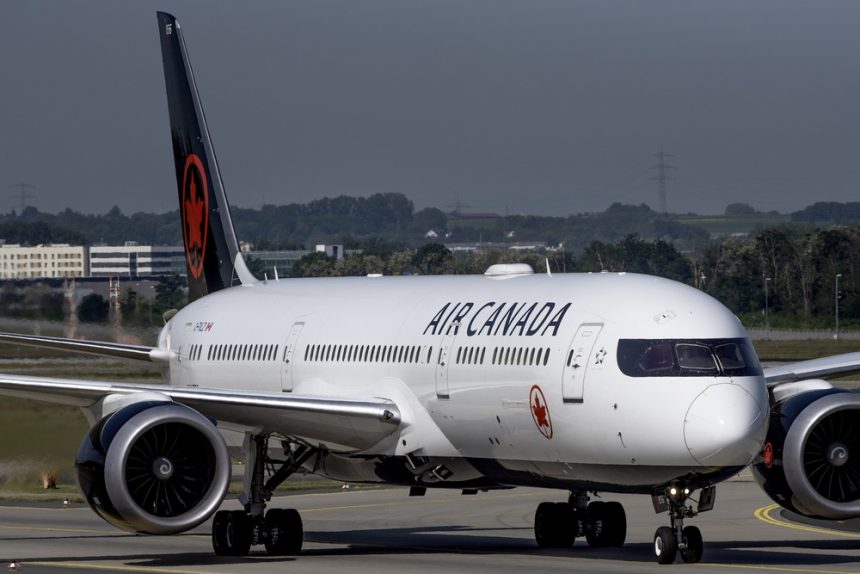
Collision with rescue vehicle triggers major disruption and safety scrutiny
A late-night collision between an Air Canada Express regional jet and an airport rescue vehicle at New York’s LaGuardia Airport has left two pilots dead, dozens injured and one of the country’s busiest air hubs temporarily shut down. The crash happened shortly before midnight on Sunday, turning a routine arrival from Montreal into a major aviation emergency and immediately raising questions about runway coordination, air traffic control and operational pressure inside the US airport system.
The aircraft involved was a CRJ-900 operated by Jazz Aviation on behalf of Air Canada. According to airport and airline statements, the plane was carrying 72 passengers and four crew members. It had just landed on Runway 4 when it struck a Port Authority aircraft rescue and firefighting truck that had entered the runway while responding to a separate emergency involving another aircraft. The force of the impact killed the two pilots and injured numerous others on board, along with personnel inside the fire vehicle.
The scale of the disruption quickly became clear. LaGuardia was placed under a ground stop shortly after midnight, and airport authorities said the field would remain closed until at least Monday afternoon to allow investigators to secure the site and begin a detailed review. Hundreds of inbound and outbound flights were canceled, adding to broader travel strain at a time when the US aviation network is already under pressure.
Emergency response became part of the accident itself
What makes the crash especially striking is that the rescue vehicle was not on the runway by mistake in any ordinary sense. It was responding to another incident, involving a United Airlines aircraft that had reportedly raised concerns about an odor in the cabin. That earlier event prompted emergency coordination and put the fire truck into motion. In the chain of decisions that followed, the truck and the arriving Air Canada jet ended up on the same runway at the same time.
Officials said the two Port Authority employees inside the rescue truck were injured and taken to hospital, though their condition was described as stable. A total of 41 people from the aircraft and response vehicle were also taken for treatment, with many later released. Still, the human toll was severe enough to transform the event from an operational failure into one of the most serious US airport ground accidents in recent years.
Audio from the control tower has intensified the scrutiny. Recordings indicate that a vehicle was cleared to cross the runway before a controller urgently ordered it to stop. Other approaching aircraft were then told to abort landings. Those details are likely to become central to the investigation because they point to possible communication breakdowns at the exact point where air and ground traffic needed to be separated most carefully.
Investigators now focus on coordination and runway safety
The National Transportation Safety Board has begun examining the collision, with the Federal Aviation Administration also involved. Early attention is expected to center on how the runway crossing was authorized, how the landing clearance was handled and whether all parties had the same understanding of the runway status in the seconds before impact.
The case is likely to renew broader debate about runway incursions, an area of growing concern in US aviation. Even when weather is manageable and aircraft are functioning normally, the greatest danger can sometimes emerge from the ground environment itself, where aircraft, service vehicles and emergency responders operate in a tightly controlled but complex choreography. When that choreography breaks down, the consequences can be immediate and catastrophic.
LaGuardia’s layout and operating intensity only add to the sensitivity. Like many major urban airports, it works with limited space, dense traffic and little room for error. Any investigation will likely examine not only the specific controller instructions on the night of the crash, but also staffing levels, procedural safeguards and whether emergency response protocols created conflicting demands on the system.
The crash adds to pressure on an already strained air system
The timing of the accident has amplified its national significance. US air travel is already experiencing disruption linked to a partial government shutdown that has affected Transportation Security Administration staffing and contributed to longer lines and operational stress at airports. While there is no evidence so far that the shutdown directly caused the LaGuardia collision, the broader environment of strain has made any serious aviation incident politically and operationally more charged.
For airlines, airport operators and regulators, the immediate task is recovery and investigation. For passengers, the impact is more direct: canceled flights, rebooked itineraries and renewed anxiety about a system that increasingly appears stretched at multiple points. The closure of LaGuardia, even for part of a day, ripples through the entire Northeast corridor and adds pressure to already crowded nearby airports.
What happened on Runway 4 is now more than a local tragedy. It is a test of how resilient US aviation procedures remain when routine operations collide with emergency response. The facts still being gathered will determine exactly where the breakdown occurred. But the broad outline is already clear. A passenger jet landed, a rescue vehicle crossed its path and a system built around precise timing failed at the worst possible moment.