
Financial markets turned defensive on Tuesday as investors confronted another deadline in the war with Iran, this time tied to President Donald Trump’s demand that Tehran reopen the Strait of Hormuz by 8 p.m. Eastern time. With no resolution in sight as the deadline approached, oil prices climbed sharply, stocks retreated and bond yields moved higher, underscoring how tightly markets are now linked to every new turn in the conflict.
The reaction reflected more than ordinary geopolitical nerves. The Strait of Hormuz remains one of the most important chokepoints in global energy trade, and the longer it stays restricted, the more investors must consider the risk of a prolonged supply shock feeding into fuel costs, transport expenses and inflation. That possibility is now hitting multiple asset classes at once, from crude and equities to Treasuries and mortgage rates.
At the center of the day’s volatility was the same question that has haunted markets for weeks: whether Trump’s latest ultimatum would produce another temporary pause or trigger a new escalation. Traders have grown used to abrupt shifts in tone from the White House, but with oil already elevated and gasoline prices rising, patience is becoming thinner.
Crude jumps as traders brace for a deeper supply shock
U.S. crude rose as high as $117.63 a barrel before easing back to around $115, while international Brent briefly touched $111.80 before settling near $109 later in the day. Even after trimming some of the earlier gains, both benchmarks remained sharply higher, showing that the market is still pricing in serious disruption to energy flows from the Gulf.
The move reflects how sensitive crude has become to developments around Hormuz. Any threat to the passage of oil through that route immediately tightens perceived supply, and in the current environment, traders are reacting not only to confirmed events but also to the risk that diplomatic efforts could fail suddenly.
That instability has left energy markets swinging on headlines, statements and social media posts rather than on normal supply and demand data alone. As long as the conflict remains unresolved, oil is likely to remain the market’s clearest signal of geopolitical stress.
Stocks slip while rates move higher
Equities also came under pressure, though major indexes recovered somewhat from their worst intraday levels by early afternoon. The S&P 500 was down 0.4%, the Nasdaq Composite lost 0.6%, and the Dow fell about 200 points, or 0.3%. The Russell 2000, which tracks smaller companies, managed a slight gain, suggesting investors were not selling every corner of the market equally.
At the same time, U.S. Treasury bonds fell, sending yields upward. The 10-year Treasury yield rose to 4.36%, adding to concern that the war’s inflationary effects may keep financial conditions tight. Mortgage markets reflected the same pressure, with the average 30-year mortgage rate edging up to 6.44%, far above the 5.99% level reached before the conflict began.
The combination of weaker stocks and higher yields is especially uncomfortable for investors because it suggests the conflict is affecting both risk appetite and inflation expectations at once. In calmer geopolitical episodes, bonds often benefit more clearly from safe-haven demand. This time, the inflation threat from oil is limiting that traditional refuge.
Fuel costs are moving closer to a consumer problem
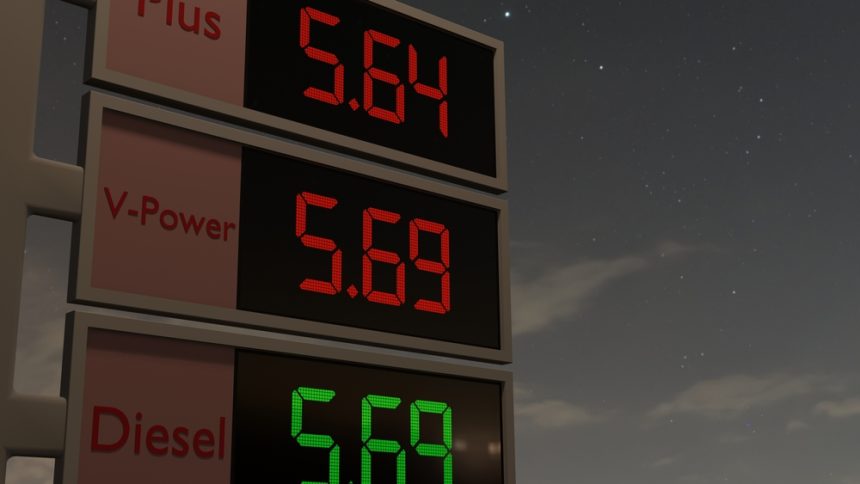
By Tuesday, the national average retail gasoline price had climbed to $4.14 a gallon, while diesel reached $5.64, close to its 2022 record of $5.82. Those levels are no longer just market statistics. They are becoming an increasingly visible burden on households, freight operators and businesses that depend on transport costs remaining stable.
The U.S. Energy Information Administration added to those concerns by projecting that gasoline prices could peak at close to $4.30 a gallon on average in April, while diesel could rise above $5.80. Those forecasts strengthen the view that the energy shock is no longer confined to futures markets. It is now flowing into the real economy in a way that could affect consumption, inflation and broader business sentiment.
That is why investors are paying such close attention to fuel. If prices keep rising, the conflict will stop being just a geopolitical event and increasingly become an economic one with wider consequences for growth and policy.
Markets still wonder whether Trump will escalate or pull back
Trump’s own messaging remained a major source of uncertainty. Early Tuesday, he wrote on Truth Social that an entire civilization would die that night if no deal were reached and the strait remained closed. Yet the same message also hinted that calmer and less radicalized minds might still prevail in talks with Iran’s leadership, offering the market a second, softer interpretation.
That ambiguity is now a defining feature of the trading environment. Since the war began on Feb. 28, Trump has repeatedly threatened escalation while also pausing strikes or extending talks at the last moment. That history has made Wall Street wary of reacting too aggressively to any single deadline, even as the economic stakes keep rising.
Analysts increasingly see two broad paths from here. One is a fragile easing in which no ground war emerges, supply disruption gradually fades and markets stabilize. The other is a more prolonged conflict, with deeper military involvement and structurally higher risk premiums across energy and financial assets. By Tuesday afternoon, markets appeared to believe the second path was becoming harder to ignore.